Home / Yarn yardage calculator
Yarn yardage calculator
Weigh a leftover ball and find out how many yards or metres are left, even with no label. Add several scraps at once and check if you have enough for your next project.
How many yards are in 10, 25 or 50 grams of yarn?
| If the label says | 5 g left | 10 g left | 20 g left | 25 g left | 50 g left |
|---|---|---|---|---|---|
| Fingering, 100 g / 400 m 4.37 yd per gram | 22 yd | 44 yd | 87 yd | 109 yd | 219 yd |
| DK, 100 g / 230 m 2.52 yd per gram | 13 yd | 25 yd | 50 yd | 63 yd | 126 yd |
| Worsted, 100 g / 200 yd 2.00 yd per gram | 10 yd | 20 yd | 40 yd | 50 yd | 100 yd |
| Worsted, 198 g / 364 yd (big acrylic skein) 1.84 yd per gram | 9 yd | 18 yd | 37 yd | 46 yd | 92 yd |
| Bulky, 100 g / 120 yd 1.20 yd per gram | 6 yd | 12 yd | 24 yd | 30 yd | 60 yd |
Worked out with the same formula as the calculator, from example labels. Yarns of the same weight vary a lot, so use your own label for a real answer. 1 yard = 0.9144 m.
How do I work out how much yarn is left in a ball?
- Find the label numbers. You need the length and the weight of a full ball, for example 200 yd and 100 g.
- Work out the length per gram. 200 ÷ 100 = 2 yards per gram.
- Weigh the leftover on a kitchen scale in grams. Put it in a small bowl if it rolls, and zero the scale with the bowl on first.
- Multiply. 37 g × 2 = 74 yards left.
The same sum works backwards. Need 120 yards? 120 ÷ 2 = 60 g, so wind off yarn until the ball has dropped by 60 g. Knitting designers and yarn shops such as Elizabeth Smith Knits and Pacific Knit Co. use exactly this method for partial skeins.
What if I lost the label?
If you know the brand and colour, look the yarn up on the maker's site or a yarn database. If not, make your own label:
- Measure off a length you can count easily, like 10 yards or 10 metres. A tape measure or a table of known length helps.
- Weigh that piece. If your scale shows whole grams only, measure a longer piece (20 or 30 yards) so the weight is at least 10 g. A 1 g error on 5 g is 20 percent; on 20 g it is 5 percent.
- Choose "I'll weigh a measured piece" in the calculator and type both numbers in. Wind the piece back on: you haven't lost it.
How accurate is weighing yarn?
- Labels are rounded. A "100 g" ball can weigh a few grams more or less, and the length on the label is the maker's estimate, so treat your answer as close, not exact.
- Your scale matters. A kitchen scale that reads in whole grams is fine for most leftovers. A small jewellery or postage scale that shows 0.1 g is better for tiny scraps and mini skeins.
- Take off the core. Big acrylic skeins, cones and some cotton balls are wound on card or plastic. Weigh an empty one and type it in so it isn't counted as yarn.
- Weigh dry yarn. Damp or freshly washed yarn weighs more.
How many skeins did my finished project use?
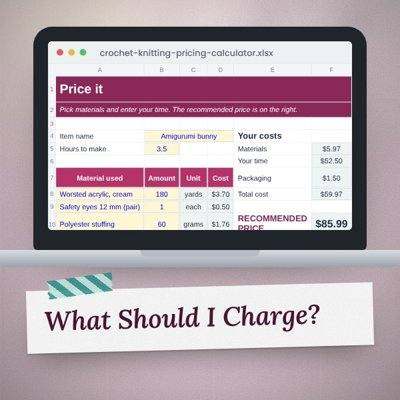
Weigh the finished piece and divide by the weight of one ball. A hat that weighs 140 g used 1.4 balls of 100 g yarn, which tells you to buy two next time. It's the quickest way to write your own pattern notes, and handy for the project tracker or pricing an item with our pricing guide.
What can I make with my leftovers?
Once you know the yards, check the amount against the yarn calculator for hats, scarves and more. Small amounts in one weight make good granny squares (see the granny square calculator), and lots of different colours are perfect for stripes. Swapping a leftover into a pattern that names another yarn? The yarn substitution calculator turns the pattern's balls into yours.
Method from Elizabeth Smith Knits, Pacific Knit Co. and Andrea Rangel's yarn weighing tutorials (formula, whole-gram scales, label weights being approximate). The measured-piece method, table and spare-yarn rule of thumb are our own.
Questions crafters ask
How do I calculate yards of yarn from grams?
Divide the yards on the label by the grams on the label to get yards per gram, then multiply by the grams you have. For a 200 yd, 100 g ball that's 2 yards per gram, so 50 g is about 100 yards.
How much yarn is left in my skein?
Weigh it in grams and multiply by the label's length per gram. If the skein is wound on a card core or cone, weigh an empty one and subtract it first.
How do I find the yardage of yarn with no label?
Measure off 10 or 20 yards, weigh that piece, and divide the length by its weight to get yards per gram. Then weigh the whole ball and multiply.
How many yards are in 50 grams of yarn?
It depends on the thickness. 50 g is about 220 yd of fingering, 125 yd of DK, 100 yd of a typical worsted and 60 yd of bulky, but check your own label because yarns vary.
Is weighing yarn accurate?
Close enough for planning. Labels are rounded and kitchen scales read to the nearest gram, so add about 10 percent spare when a leftover only just covers a project.
How do I know how many skeins I used?
Weigh the finished project and divide by the weight of one full skein. A 140 g hat used about 1.4 skeins of 100 g yarn.
Free printable sampler
Journaling cards, a vintage ephemera sheet and a planner page from our shop, free to print. Plus new freebies and pattern ideas now and then.
Free. No spam, unsubscribe in one click. See our privacy policy.